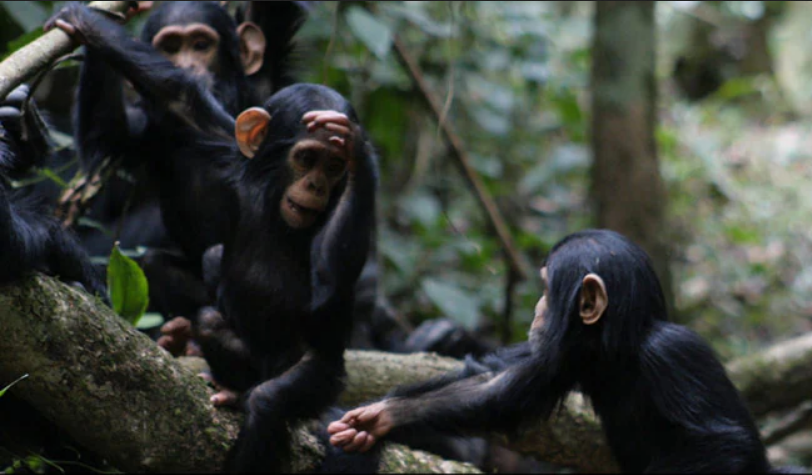
Researchers argue that, despite not employing gestures themselves, humans possess the ability to comprehend gestures produced by other great apes. A video-based inquiry conducted by researchers at St Andrews University, revealed on Tuesday, reached this conclusion by having volunteers interpret ape motions.
The study, published in the academic journal PLOS Biology, focused on people’s understanding of the 10 most common gestures performed by chimpanzees and bonobos. To gather data, researchers employed an online game, where 5,656 participants were tasked with selecting the meaning of chimpanzee and bonobo gestures in 20 videos.

“We demonstrate that humans may maintain an understanding of ape gestural communication (either directly inherited or part of more general cognition), across gesture types and meanings, with information on communicative context providing only a marginal improvement in success,” stated the study.
The researchers emphasized that, for the first time in adult humans, they accessed part of the great ape gestural repertoire. Dr. Kirsty Graham, the lead researcher from St. Andrews University, noted, “Cognitive access to an ancestral system of gesture appears to have been retained after our divergence from other apes, drawing deep evolutionary continuity between their communication and our own.”

Dr. Catherine Hobaiter, the co-author of the study, expressed amazement at the findings, saying, “On one hand, it’s really incredible that we’re able to do this… We can decode these gestures almost instinctively. It’s a useful reminder that we are also great apes! And that, even though today modern humans have language, we’ve kept some understanding of our shared ancestral system of ape communication.”